
What Size Lot Do I Need to Build an ADU in Savannah, GA?
Quick Answer:
There is no single lot size that automatically qualifies a property for an ADU in Savannah, GA. Whether you can build a carriage house, garage apartment, or accessory dwelling unit depends on your zoning district, setbacks, lot coverage, buildable area, utility access, and site constraints—not simply the total size of your lot. In many cases, a smaller lot with a good layout can be more suitable than a larger lot with significant restrictions.
One of the most common questions homeowners ask when exploring an ADU is surprisingly simple:
“Is my lot big enough?”
The challenge is that lot size alone rarely provides the answer.
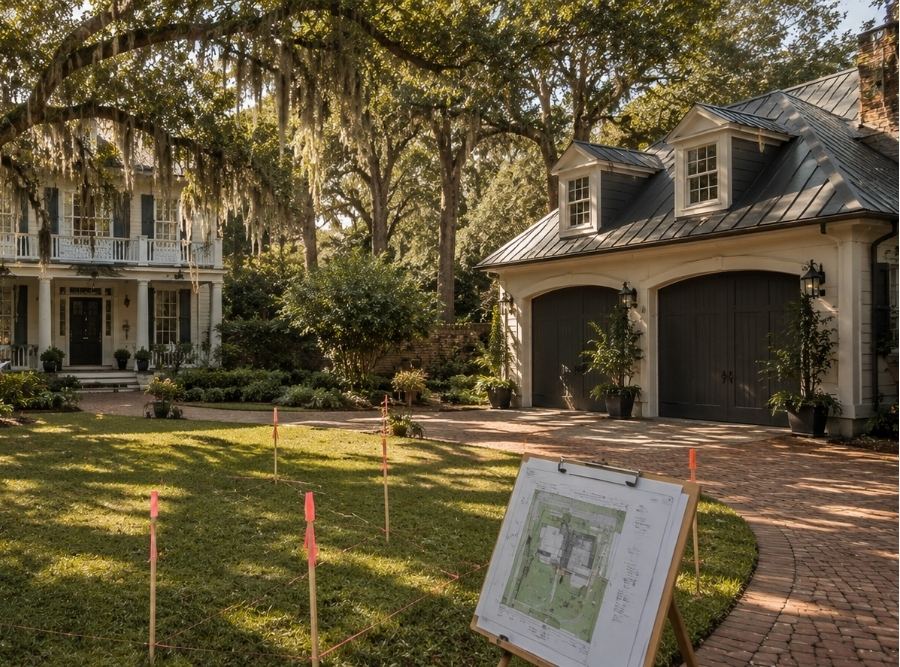
Across Savannah, homeowners often look at a spacious backyard, an underused side yard, or the area behind an existing garage and assume there is plenty of room for a carriage house or guest cottage. Then the survey arrives, setbacks are mapped, utility locations are identified, and the available building area becomes much smaller than expected.
This is why two properties with identical square footage can have completely different ADU potential.
Throughout Savannah neighborhoods such as Ardsley Park, Thomas Square, Isle of Hope, Wilmington Island, The Landings, and portions of the Historic District, the question is usually not how large the lot is. The real question is how much of the property is actually buildable.
Lot Size Is Only One Piece of the Puzzle
Many homeowners begin by searching for a minimum lot size requirement.
While zoning regulations do establish minimum lot-area standards in certain districts, those standards are only one part of the evaluation process. Savannah’s ADU regulations have evolved over time, and eligibility often depends on how the lot functions rather than simply how many square feet it contains.
A property may technically meet minimum lot-area requirements while still struggling with setbacks, drainage constraints, utility conflicts, tree preservation requirements, or limited access.
Conversely, some smaller lots may successfully accommodate an ADU because their layout creates a more usable building envelope.
What Determines Whether a Lot Can Support an ADU?
- Zoning district requirements
- Available buildable area
- Front, side, and rear setbacks
- Existing structures on the property
- Lot coverage limitations
- Easements and utility corridors
- Historic district requirements
- Access and circulation
- Drainage and stormwater conditions
- Utility availability and capacity
The most successful ADU projects begin with a site-specific feasibility review rather than assumptions based solely on lot dimensions.
Buildable Area Matters More Than Total Square Footage
One of the biggest surprises homeowners encounter is discovering that a large portion of their property may not actually be available for construction.
Setbacks create invisible boundaries around the property. Utility easements can prohibit construction in key areas. Mature live oak trees may require preservation zones. Existing garages, sheds, pools, patios, and driveways all consume space that many homeowners unconsciously include when estimating available room.
This is particularly common in older Savannah neighborhoods where lot layouts evolved over decades rather than being planned around modern ADU standards.
Early Signs a Property May Have Less Buildable Space Than Expected
- Existing garage sits close to property lines
- Large trees occupy the rear yard
- A pool already consumes significant backyard area
- Utility easements cross the lot
- Drainage problems occur after heavy rainfall
- Property lines are unclear
- Existing sheds limit placement options
- Alley access is tighter than it appears
- Historic review affects building location
- Site plans keep shrinking during design
Many homeowners experience a moment when the lot suddenly feels much smaller than it did during the initial walkthrough. That is not because the property changed. It is because the buildable envelope finally became visible.
Savannah’s Older Neighborhoods Create Unique Challenges
Savannah’s character is one of its greatest strengths, but it also creates site-planning realities that newer suburban developments rarely face.
In areas such as Ardsley Park, Chatham Crescent, Gordonston, Thomas Square, and portions of the Historic District, lots often contain mature landscaping, detached garages, irregular property lines, historic structures, and infrastructure that predates modern development standards.
Common Reasons ADU Designs Need Revision
- Setbacks eliminate the preferred building location
- Existing garages occupy the ideal footprint
- Utility locations create conflicts
- Historic review requires relocation
- Drainage concerns affect placement
- Access becomes difficult for construction equipment
- Tree preservation limits development area
- Lot coverage calculations exceed allowable limits
- Narrow lot dimensions reduce design flexibility
- Existing improvements interfere with utility connections
These challenges do not necessarily prevent an ADU project.
They simply reinforce the importance of understanding the property before investing heavily in architectural plans. One of the most expensive mistakes homeowners make is designing first and verifying feasibility second.
A Large Backyard Does Not Automatically Mean You Can Build
This is perhaps the most important misconception surrounding ADU projects. Homeowners often stand in the middle of a backyard and see what appears to be plenty of available space. What they are seeing is open land.
What the city evaluates is buildable land.
The difference matters.
A backyard may contain setbacks, drainage easements, utility corridors, tree-protection zones, access limitations, and stormwater considerations that dramatically reduce where an ADU can be placed.
What Homeowners Commonly Overlook When Evaluating Their Lot
- Setback requirements
- Easement restrictions
- Drainage infrastructure
- Utility access points
- Tree-protection areas
- Historic district requirements
- Access for construction equipment
- Fire separation requirements
- Utility trenching routes
- Future maintenance access
Ignoring these factors often leads to redesigns, permit delays, and additional costs that could have been identified much earlier in the process.
Historic District and Conservation Areas Add Another Layer
Properties located within Savannah’s historic and conservation districts often face additional considerations beyond standard zoning requirements.
A lot may physically accommodate an ADU while still requiring review regarding placement, scale, architectural compatibility, visibility, and relationship to surrounding structures. Historic review is not necessarily a barrier, but it can influence where and how an accessory dwelling is designed.
This is one reason why two seemingly identical lots may produce very different outcomes depending on their location within the city.
Understanding those requirements early helps avoid investing in a design that ultimately requires substantial revisions.
The Best Question Isn’t “How Big Is My Lot?”
The best question is:
“How much buildable area does my property actually have?”
That shift in perspective often changes the entire conversation.
A successful ADU project is rarely determined by acreage alone. It depends on how the lot functions, how existing improvements interact with zoning requirements, how utilities can be extended, and how the structure fits within the property’s broader context.
The strongest projects begin with a realistic evaluation of the site before anyone becomes emotionally attached to a particular floor plan.