
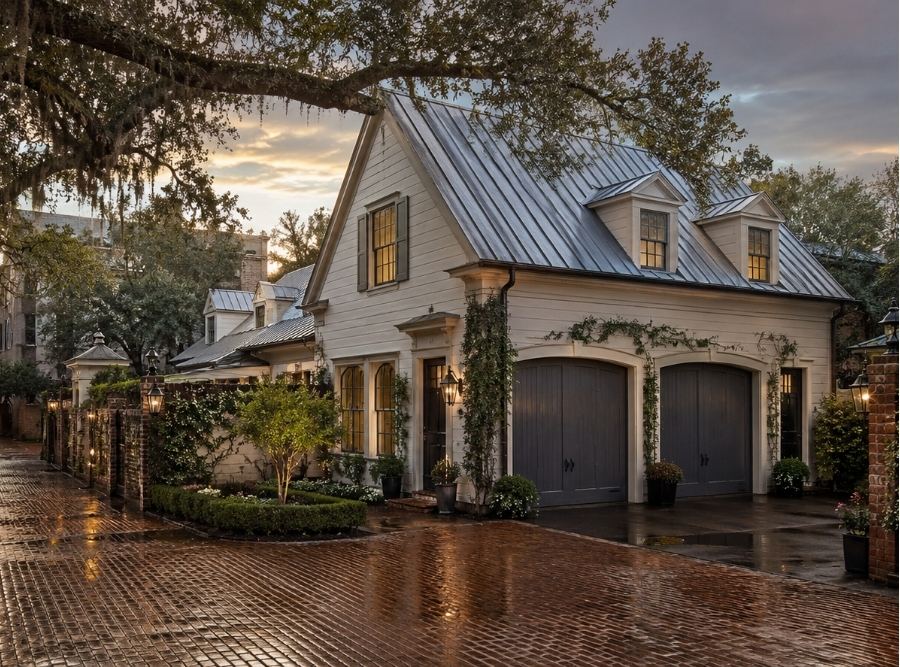
Can I Build a Carriage House in Savannah, GA?
Quick Answer:
Yes, many Savannah properties can legally accommodate a carriage house, also known as an accessory dwelling unit (ADU), guest cottage, garage apartment, or detached secondary dwelling. However, whether you can build one depends on your property’s zoning, lot size, setbacks, historic district status, site constraints, and compliance with Savannah’s permitting and design requirements.
Building a carriage house is one of the most common questions homeowners ask throughout Savannah, particularly in neighborhoods where detached garages, rear-lane access, and historic accessory structures are already part of the architectural landscape. It sounds like a simple idea on the surface. A homeowner sees an underused backyard, an aging garage, or a family need for additional living space and assumes a small detached dwelling should be straightforward to add.
In reality, the answer is rarely determined by the building itself.
The bigger question is whether the property can support a second dwelling from a zoning, design, infrastructure, and site-planning standpoint. Long before construction drawings, cabinetry selections, or rental plans enter the conversation, the city is evaluating whether the proposed carriage house belongs on the lot in the first place. That distinction explains why some projects move forward smoothly while others encounter months of redesign, review comments, and permitting delays.
Across Savannah, from Ardsley Park and Isle of Hope to Wilmington Island, The Landings, Thomas Square, and the Historic District, homeowners are increasingly exploring carriage houses for multigenerational living, guest accommodations, aging parents, adult children, long-term rental opportunities, and future flexibility. Yet the strongest projects begin with feasibility rather than floor plans.
A Carriage House Is Usually Considered an ADU
One of the first sources of confusion is terminology.
Many homeowners use phrases like guest house, backyard cottage, mother-in-law suite, tiny house, garage apartment, or carriage house interchangeably. While those descriptions may feel different, Savannah generally evaluates most of these projects through the framework of an accessory dwelling unit or secondary dwelling.
That matters because the project is no longer viewed as a simple accessory structure. Once a building contains living space with sleeping areas, bathrooms, kitchens, or independent occupancy potential, it typically triggers a much more comprehensive review process involving zoning, building code, utilities, life-safety requirements, and potentially historic review.
A structure that people will live in carries an entirely different set of requirements.
The Lot Often Determines the Answer Before the Design Does
One of the most common mistakes homeowners make is designing the carriage house first and evaluating the lot second.
The reality is that the lot usually determines whether the project is viable before architectural details become relevant. Savannah’s zoning regulations evaluate factors such as lot size, setbacks, lot coverage, building placement, height limitations, access, and permitted uses before approving additional dwelling units.
Before a Carriage House Design Moves Forward, the Property Usually Needs to Support:
- Appropriate zoning for an accessory dwelling or carriage house
- Adequate lot size and buildable area
- Compliance with setback requirements
- Lot coverage and building footprint allowances
- Utility access for water, sewer, and electrical service
- Safe access and circulation throughout the property
- Drainage and stormwater considerations
- Floodplain requirements where applicable
- Historic district or architectural review compliance
A backyard may appear large enough at first glance, but surveys, easements, tree protection zones, drainage conditions, and setback requirements often reveal a different picture. Understanding those realities early helps prevent expensive redesigns later in the process.
This is why two seemingly similar properties can have completely different outcomes. A homeowner may see a neighboring carriage house and assume the same opportunity exists next door. However, the neighboring lot may have different dimensions, zoning classifications, historic approvals, utility locations, or grandfathered conditions that are not immediately visible from the street.
Historic District Properties Introduce Additional Layers of Review
Savannah’s historic character is one of the city’s defining strengths, but it also adds complexity to many carriage house projects.
In areas such as the Historic District, Victorian District, Thomas Square, and other preservation-sensitive neighborhoods, homeowners may encounter additional design review requirements beyond standard permitting. Exterior appearance, roof forms, materials, proportions, massing, visibility, and architectural compatibility can become significant parts of the approval process.
Common Reasons Carriage House Projects Get Delayed
- Designing before confirming zoning eligibility
- Discovering setback conflicts after drawings are complete
- Historic review requiring exterior revisions
- Utility locations creating unexpected redesigns
- Drainage concerns affecting building placement
- Tree protection requirements limiting construction areas
- Parking assumptions that do not match site realities
- Rental-use plans conflicting with local regulations
- Permit resubmittals after design revisions
- Lot coverage calculations reducing the available footprint
Many homeowners are surprised to discover that the delay is not the construction itself. More often, the delay occurs while the project is being reshaped to fit the realities of the property. The sooner those realities are identified, the smoother the path tends to be.
Existing Garages Are Often More Complicated Than They Appear
Many homeowners begin the process believing an existing detached garage can simply be converted into a carriage house.
Sometimes that is possible.
Frequently, however, the structure was never designed to function as habitable living space.
Common Issues Found During Garage and Carriage House Conversions
- Undersized framing that does not meet current residential standards
- Inadequate foundations or aging concrete slabs
- Moisture intrusion and humidity-related deterioration
- Termite damage hidden within wall assemblies
- Insufficient insulation and air sealing
- Electrical systems lacking capacity for residential use
- Ceiling heights that fall short of habitable-space requirements
- Stair layouts that do not comply with modern codes
- Plumbing and sewer connections located farther away than expected
- Poor ventilation that creates long-term comfort and moisture problems
What initially looks like a simple conversion frequently becomes a more comprehensive rebuilding effort once the structure is evaluated properly. In Savannah’s humid coastal environment, many of these conditions remain hidden until demolition begins and the building’s true condition is exposed.
The phrase “we already have a garage” sounds like a shortcut. In practice, it often becomes one of the most important evaluation points in the entire project.
Coastal Conditions Affect Carriage House Design More Than Many Homeowners Expect
Savannah’s climate introduces considerations that homeowners from other regions rarely encounter.
Humidity, heavy rainfall, salt exposure, storm events, high water tables, and drainage challenges all influence how accessory dwellings should be designed and built. Detached structures frequently experience these environmental pressures more aggressively than primary homes because they are smaller, less consistently occupied, and often located in more exposed portions of the property.
Why Savannah Carriage Houses Require More Planning Than Homeowners Expect
- Coastal humidity affecting long-term building performance
- Heavy rainfall creating drainage challenges
- Floodplain requirements influencing foundation design
- Salt-air exposure accelerating exterior wear
- Termite pressure in damp structures
- Live oak preservation zones affecting site layout
- Utility trenching through established landscapes
- Heat buildup in upper-level garage apartments
- Moisture management inside detached structures
- Long-term durability expectations in luxury neighborhoods
A carriage house that works beautifully on paper can become uncomfortable, damp, or maintenance-intensive if humidity management, drainage, ventilation, and building-envelope performance are not addressed thoughtfully from the beginning.
One of the biggest mistakes homeowners make is assuming a carriage house should simply look good when construction is complete. The better question is how the structure will perform five, ten, or twenty years later.
The Most Successful Projects Start With Feasibility, Not Renderings
One of the strongest indicators of a successful carriage house project is the order in which decisions are made.
Homeowners naturally become excited about layouts, elevations, finishes, and potential uses. Yet the projects that move most efficiently through design and permitting typically begin with a much less glamorous step: confirming feasibility.
Before anyone becomes attached to a floor plan, it is worth understanding whether the lot supports the intended use, whether historic review may apply, how utilities will connect, whether drainage creates limitations, and how the proposed structure fits within zoning requirements.
That early diligence often prevents expensive redesigns later.
A Well-Planned Carriage House Can Become One of the Most Valuable Parts of a Property
Savannah’s long history of carriage houses, rear-lane dwellings, and accessory living spaces demonstrates that these structures can become far more than backyard buildings. Thoughtfully designed carriage houses can provide multigenerational living space, guest accommodations, long-term flexibility, aging-in-place solutions, and future rental opportunities while strengthening the overall functionality of the property.
The best carriage houses feel like they have always belonged on the property. They respect the site’s constraints, respond to Savannah’s climate, complement the main residence, and support how the property will be used for years to come.
Baywater Custom Builders works with homeowners throughout Savannah, Isle of Hope, Ardsley Park, Wilmington Island, The Landings, and surrounding Lowcountry communities to evaluate ADU feasibility, carriage house construction, garage apartment conversions, and guest cottage projects with a focus on architectural integrity, coastal durability, thoughtful planning, and long-term value.