
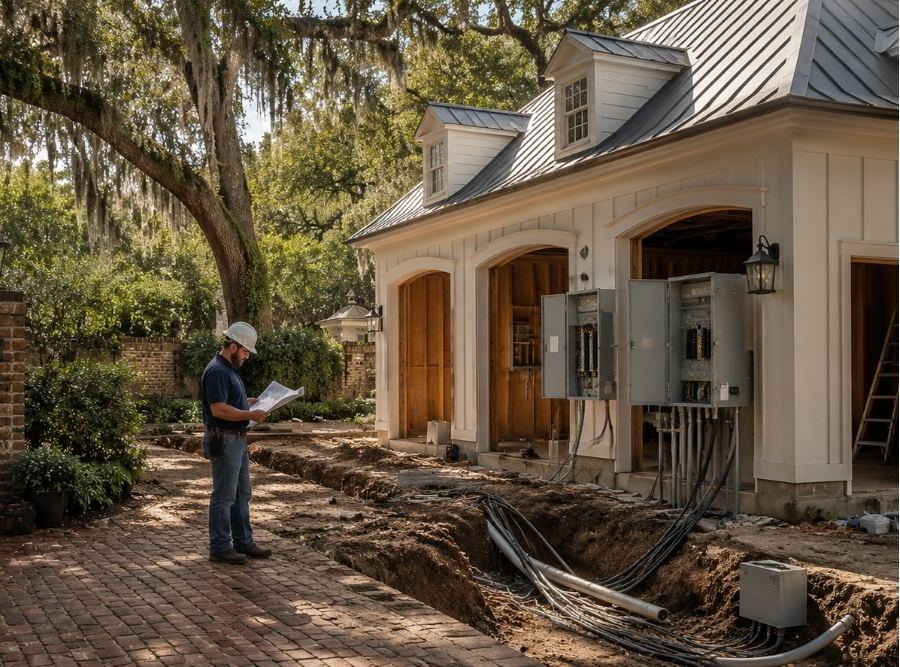
Can an ADU Share Utilities With the Main House in Savannah, GA?
Quick Answer:
Yes, an ADU can often share utilities with the main house in Savannah, GA. In many cases, accessory dwelling units use the same water, sewer, and electrical service as the primary residence. However, whether the existing utility infrastructure has enough capacity and whether a separate meter makes sense for future rental use is often a more important question than whether shared utilities are allowed.
Most homeowners begin the conversation focused on the building itself.
They think about floor plans, guest accommodations, rental income, aging parents, or converting an underused garage into a carriage house. Then somewhere during design, permitting, or budgeting, the conversation suddenly shifts.
- The contractor asks about the electrical panel.
- The utility company wants additional information.
- The electrician starts talking about load calculations.
- The water service becomes part of the discussion.
Suddenly, the utility infrastructure is receiving as much attention as the ADU itself. That surprises many homeowners because utility planning feels like a secondary issue. In reality, utility capacity often determines project cost, complexity, and long-term functionality just as much as the structure being built.
Throughout Savannah, from Ardsley Park and Isle of Hope to Wilmington Island, The Landings, and the Historic District, one of the most common questions homeowners ask is whether a carriage house, garage apartment, or backyard cottage can simply tie into the existing house utilities.
In many cases, the answer is yes.
The bigger question is whether the existing infrastructure was designed to support another household.
Shared Utilities Are More Common Than Many Homeowners Realize
One of the biggest misconceptions surrounding ADUs is that every unit automatically requires separate utility services.
That is not necessarily the case.
Savannah’s ADU framework specifically contemplates accessory dwellings connecting to the principal dwelling’s utility systems. Depending on the property and project, water, sewer, and electrical service may be shared with the primary residence rather than requiring entirely separate infrastructure.
What Utilities Are Commonly Shared Between an ADU and Main House?
- Electrical service
- Water service
- Sewer connection
- Natural gas service
- Internet infrastructure
- Irrigation systems
- Exterior lighting circuits
- Shared utility trenches and service pathways
For homeowners building an ADU for family members, guests, or occasional occupancy, shared utilities often provide the simplest and most cost-effective solution. Instead of installing entirely new utility services, the accessory dwelling can frequently connect to systems already serving the property.
However, simplicity and suitability are not always the same thing. A utility setup that works perfectly for a mother-in-law suite may become problematic if the ADU later transitions into a long-term rental or heavily occupied guest residence.
Existing Infrastructure Often Determines the Real Cost
Many homeowners assume the utility conversation begins once construction starts.
In reality, it should begin much earlier.
The ability to share utilities does not automatically mean the existing systems can support the additional demand. An ADU introduces new electrical loads, additional plumbing fixtures, HVAC equipment, kitchen appliances, laundry equipment, internet usage, and year-round occupancy patterns that may be significantly different from what the original home was designed to handle.
Early Signs the Existing Utility Service May Need Upgrades
- Breakers already trip occasionally
- The electrical panel appears full
- The home has older service equipment
- Water pressure drops during heavy use
- The property has undergone multiple additions over time
- HVAC systems already push capacity limits
- Utility bills seem unusually high
- Existing sewer infrastructure is decades old
- The home has never received a major electrical upgrade
- Contractors immediately ask about panel size
These warning signs are especially common in Savannah’s older neighborhoods. Homes in areas such as Ardsley Park, Gordonston, Thomas Square, and portions of Isle of Hope often contain utility infrastructure that was installed long before anyone imagined adding another dwelling to the property.
A homeowner may be planning a relatively modest carriage house while unknowingly facing a substantial electrical service upgrade. In some projects, the utility work becomes one of the largest hidden expenses discovered during planning.
Separate Meters Are Not Always Better
One of the most persistent myths surrounding ADUs is that separate utility meters are automatically the superior solution.
In reality, the answer depends entirely on how the property will be used.
Separate metering creates clear billing separation and can simplify management when an ADU functions as a long-term rental. At the same time, installing separate utility services often introduces additional cost, permitting requirements, coordination with utility providers, and infrastructure upgrades.
For some homeowners, particularly those planning family occupancy, a shared utility arrangement may remain the most practical long-term solution. For others, particularly investors or homeowners anticipating future rental income, separate metering may create greater flexibility.
The important point is that separate meters are a strategic decision, not an automatic requirement.
Rental Use Often Changes the Utility Conversation
One of the most common patterns builders encounter involves a homeowner who initially plans an ADU for personal or family use.
Then circumstances change.
- An aging parent relocates.
- An adult child moves out.
- The guest cottage becomes a rental opportunity.
- The carriage house begins generating income.
Suddenly, a utility arrangement that felt simple during construction becomes more complicated.
Common Problems When ADUs Become Rentals Later
- Utility billing disputes
- Difficulty separating usage between occupants
- Tenants questioning utility allocations
- Informal reimbursement arrangements
- Unexpected utility increases
- Future requests for submetering
- Property management complications
- Changes in occupancy patterns
- Accounting challenges during resale
- Long-term recordkeeping concerns
This does not mean shared utilities are wrong.
It simply means homeowners should think carefully about where the property may be five or ten years from now rather than focusing exclusively on today’s intended use. The most successful ADU projects are often designed around future flexibility rather than current circumstances alone.
Older Savannah Properties Create Unique Utility Challenges
Savannah’s housing stock adds another layer of complexity to utility planning.
Many of the city’s most desirable neighborhoods contain homes that were built decades before modern electrical demands existed. Historic properties, older garages, detached carriage houses, and legacy family homes often have utility infrastructure that reflects a different era entirely.
Why Utility Planning Is Often More Complex in Older Savannah Properties
- Historic electrical systems
- Aging sewer laterals
- Limited panel capacity
- Utility equipment located far from proposed ADUs
- Tight urban lots
- Live oak root systems affecting trenching
- Historic district constraints
- Corrosion from humidity and coastal conditions
- Infrastructure never designed for multiple households
- Limited access for utility upgrades
These challenges do not necessarily prevent an ADU project. They simply reinforce the importance of evaluating infrastructure early.
A beautifully designed carriage house can quickly become more expensive if utility limitations are discovered after architectural plans are already complete.
The Best Utility Strategy Supports Long-Term Goals
One of the most valuable things homeowners can do during ADU planning is stop thinking of utilities as a technical afterthought.
Utility infrastructure is part of the long-term strategy of the property.
The decision to share utilities, install separate meters, upgrade service capacity, or create future flexibility affects not only construction costs but also rental options, maintenance responsibilities, property management, and future resale considerations.
The strongest ADU projects are rarely the ones that simply minimize upfront utility costs.
They are the ones that align utility planning with how the property will actually function for years to come.
Whether the goal is a family guest cottage, a multigenerational living arrangement, a carriage house apartment, or a future income-producing property, utility decisions should support that vision rather than react to it later.
Baywater Custom Builders works with homeowners throughout Savannah, Isle of Hope, Wilmington Island, Ardsley Park, The Landings, and surrounding Lowcountry communities to evaluate ADU feasibility, utility infrastructure, carriage house construction, and long-term planning considerations before costly surprises emerge during construction.